Tuesday, February 10, 2015

Style


“I want to find my own style” is a comment I often hear from artists.  I had a student ask me the other day, how I developed my “style”. Of course, that got me to thinking about the whole concept.  I told her that “style” just comes about in a natural way; eventually you synthesize all the different approaches you have experimented with.  You filter through all the information you have absorbed and hold on to the parts that feel authentically “you”.

I have since thought of a pretty good analogy. We all remember learning to write in cursive. Some of us even remember learning the “Palmer Method”. How many of us have handwriting that really resembles that anymore? For a while, if you were anything like me, you experimented with what you wanted your handwriting to “look” like. I tried writing with no slant, with a backward slant, lots of loops, no loops. I had a name that ended in “y” which provided endless variations. But somewhere along the way, I settled into my “style” of writing. It wasn’t some intentional occurrence, it just happened. Handwriting experts claim they can tell a lot about someone by the way they write, and everyone’s style is unique. Painting is just another form of mark making, once you have achieved a certain level of confidence and ability, style will just happen all on it’s own.

Just paint, paint a lot.


Tuesday, August 26, 2014

Watching vs. Doing


Relinquish 30" x 30" mixed media

An artist friend that just watched my video commented that she wanted to see me paint more in it. I chuckled at that.  Everyone wants to see how the magic happens, but I’ve come to think that it can become a diversion to someone else’s process to spend too much time watching mine.  I mean, I paint the way I paint because of the myriad of experiences I’ve encountered. The fact that I studied etching and printmaking as an undergrad, my struggles with crossing from black and white to color, my stint as a computer programmer, my somewhat melancholic outlook on life, my struggle to understand the purpose of it all. All these things influence the way I place a mark on the canvas. I don’t drip a line just because I can; I drip it because something cries out in me that can only be expressed by that drip.  For someone else to see that and think, hey, that dripping is cool and then to drip just to drip would be to miss the point.

 I think I mentioned before the book “No More Secondhand Art” by Peter London.  One of my favorite quotes is “It is better to rise to the questions Monet did then to mimic his responses”.  I think that watching other artists paint seduces us into wanting to mimic their responses, and we are such good imitators! It is so much easier to try on and experiment with someone else’s innovations and discoveries that to face the blank canvas and find our own voice and mark that evokes it.

I believe that Art is about more than technique, and technique is about more than a toolbox of tricks. In order to discover who we are as unique individuals with something personal to say through our art, we have to find our own way of ordering marks and colors. That is why I feel my best service, as a teacher, is to help each artist put together a toolbox of skills that they can then use to go out and innovate with. They must discover all the marks that only they can make, all the colors that they can mix, first hand, by doing!

My process has developed over a lifetime of moving marks and paint around on the canvas.  It also doesn't follow the same approach every time. How can I demonstrate that? I try to remain open to discovery and chance each time I face the canvas, because I feel that is what life is about.  Here is an example of the above painting in process, and I think watching it evolve over the course of several weeks shows how open I am to letting the painting take it's own direction. Go out and paint, stop worrying about how to do it, stop watching how everyone else is doing it, take a tip from Nike and "Just do it"!


Monday, June 2, 2014

Taking Risks


Last week I was totally inspired by the start I had on this painting.  I was so connected, in the moment, and the marks seemed to just channel through me. Fortunately, I took some photos along the way, so I have a memory and record of it to share here, for now it has been lost through my attempts to complete it. But, I am not going to beat myself up over it. It had some legitimate compositional errors (the above is a cropped detail, the original is 30x36) that needed to be addressed and I wasn’t going to let those remain even if others were willing to overlook them. I also didn't want to just crop the piece down to the composition that worked. As artists, if we aren’t willing to take risks in our work, we will never move beyond what we already know. We will continue to create work that is familiar and comfortable to us.  I took a risk, it didn’t pan out.  But I reserve the right to take that risk and not stop working when it reaches someone else’s idea of finished.  This isn’t an original thought. I went to a talk given by Amy Silman at the ICA in Boston (http://www.icaboston.org/exhibitions/exhibit/AmySillman/).  She remarked that she hated the question “When do you know a piece is finished”. She vehemently stated, “When I say it is!”  She said that she retains the right to totally destroy a piece in the process.  I concur. There were many discoveries I made while working on this piece that I will carry into future pieces, and I haven’t given up hope that this painting will become something respectable eventually.  I rarely abandon a painting, it may take years but sooner or later I will have recovered from the memory of what it once was, and I will discover what it can be now. Stayed tuned for the future incarnation!

Thursday, February 27, 2014

All About Seven

I am part of an exhibit currently at the Cape Museum of Art.  The reception is this Saturday evening, March 1, 2014.  This exhibit includes 7 groups of 7 women. Each group of women picked a topic relating to seven.   My group chose the seven faces of intention as referenced in Wayne Dyer's book "The Power of Intention".   We settled on this shortly after the tragic Boston marathon bombing, and felt the world could certainly benefit if it could only manifest these intentions.

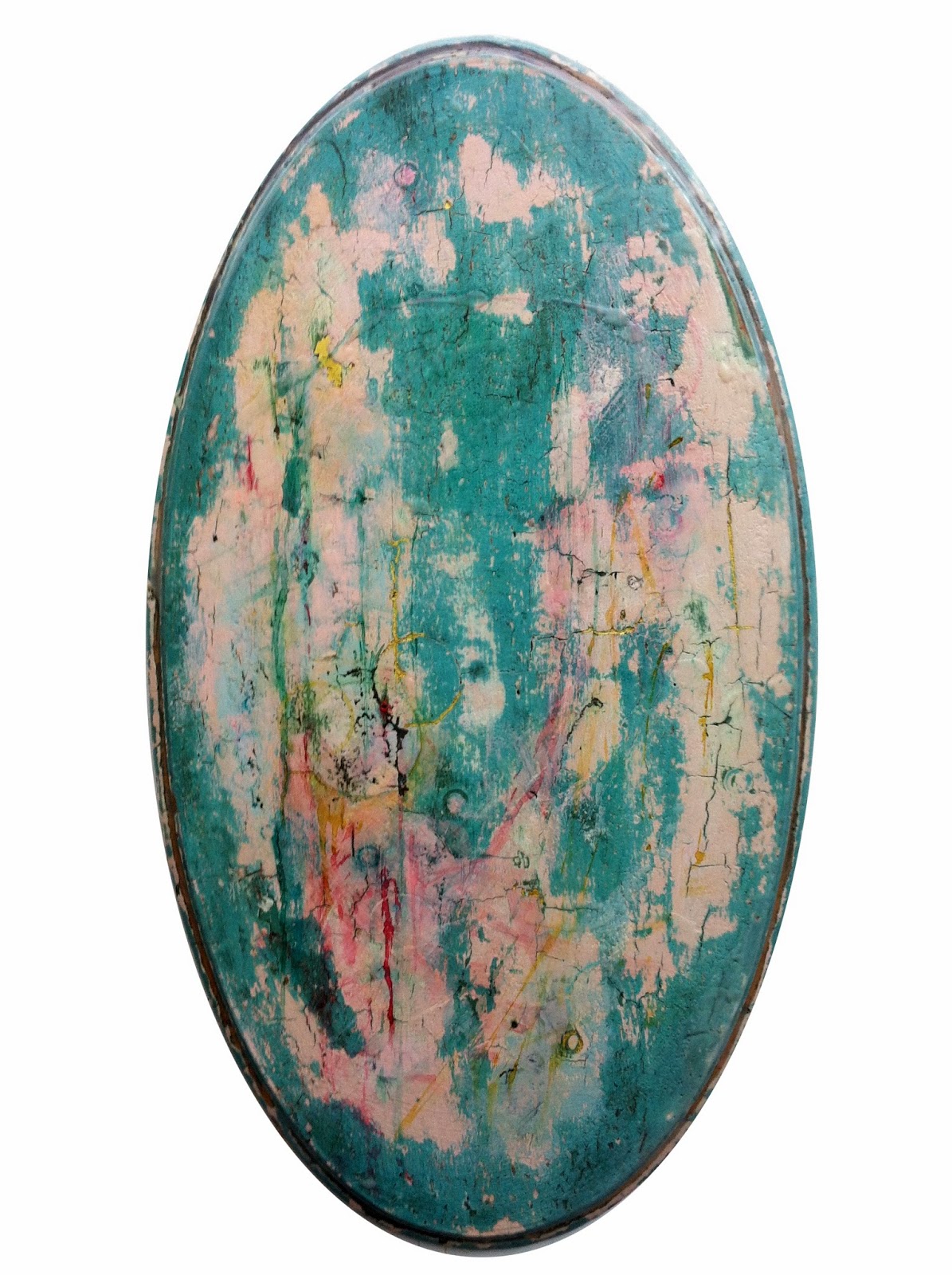
The intention I chose was "Kindness".   I decided to post a blog entry here about my struggle to create this piece.  I hope you have a chance to go and see it in person, as the photo does not begin to do it justice. The exhibit will be up through March 31st.

Kindness

My challenge in this endeavor was to express the concept of kindness without resorting to an illustration of someone or something we equate with kindness.  I wanted to evoke the impression of kindness without illustrating it.

I spent a long time just thinking about what kindness would look and feel like in abstract concepts.  What shape is kindness, what color, what type of marks.  At some point the image of an oval took shape in my mind. For me, an oval carried a certain type of presence.  The verticality, referenced the human body, the oval felt inviting and encompassing, compassionate.  So the search was on for an oval piece of wood. I enlisted the aid of a friend of mine that often helped out in estate sales. I told him to keep his eye open for on oval tabletop.  I still hadn’t figured out what sort of imagery or colors would evoke kindness.  I found an inexpensive veneer table at a thrift store for backup, in case my friend never uncovered anything better.  I was uninspired by the veneer table, but I still responded to the shape, it felt right.

After a couple months of pondering, I received a phone call from my friend saying that he had found a table, but that it was old and had several layers of paint on it and he asked me if I wanted him to sand it down a bit. I was thrilled. I asked him if he could take off the legs as well, and that if he wanted to sand it a bit that would be great, to “knock himself out”.  I was anticipating that I would need to gesso it to prep for the painting and the sanding would speed my process. 

What I didn’t anticipate was the innate beauty of the scarred tabletop revealed by the random sanding.  When my friend presented me with it, I gasped.  He has no artistic training, and probably thought I was crazy, to him it was just a worn table top desperately in need of a paint job. But to me it evoked a lifetime of service.

At that point, it was obvious to me that I needed to work with what had been revealed and not totally obfuscate it.  The whole process had involved kindness on the part of my friend.  He had searched, he had found, and he had prepared the table. It was his offering of kindness to me.

I began to slowly respond to the marking left by years of use.  There were circular rings left from sweating water glasses, and other circular marks I couldn’t identify.  There were deep cracks that refused to be healed by my layers of hot wax that I applied in light colored glazes.  I began to appreciate those cracks, and the delicacy of their mark. I opted to work with the colors that remained stubborn to the sanding attempts. Kindness requires that sort of stubbornness, that persistence.  I worked to unify the existing marks and introduced more circular elements and a rhythmic movement.  However, the real kindness in this piece is the complete conceptual package, all the pieces that brought it to life, including all the years it spent in service as a humble table.


Sunday, January 19, 2014

I Believe


The other day a student asked me whether I could come up with four or five questions that an artist could internally ask to help figure out where they want to go with their work. I wish I could think of an easy answer, but I fear it is a life long pursuit. That is both the good and bad news. If there were an end to the journey, then once it was reached what incentive would there be to press on? The bad news is that this means you are embarking on a journey of self-discovery that will more than likely be never ending, with the destination always feeling just beyond your reach. The more we know, the more we realize there is to know. At first it is easy because your focus is on perfecting the craft of your work. The real struggle only begins once you have achieved most of the technical hurdles.  That is the point when you must no longer draw from what is outside of you, but begin to draw from the well within you. This may feel daunting at first, but you need to just focus on the next step of your journey.

I believe there is more to art than just reproducing what something looks like. I say “just” but I realize that painting what something “looks” like is not an easy task, which is why so many artists continue to spend so much time trying to do just that.  Don’t misunderstand me, I am not discounting the need to perfect craft, I just don’t think that is the final destination. Once craft is perfected we may find ourselves thinking “now what?”  If perfecting craft is your present goal along this journey and it brings you satisfaction, then continue on. When the goal of perfecting craft has been achieved, you may feel yourself questioning whether there is something more to discover.

This does not have to be some sort of deep trip into psycho self-analysis.  But, it is the realization that all art is a form of communication. There is room for all levels of communication. It depends on what you are trying to communicate and who you want to be in conversation with. I think that music is a good analogy. Musicians must hit the right notes, but great musicians do more than hit the right notes, they impart something of themselves in the performance. There is more than the accuracy of their craft. There is something that can’t be described. That “something” is fleeting in a musical performance, as painters, we seek to give that “something” permanence in paint. Kandinsky did his best to explain this phenomenon.  He felt that a work of art is a physical object that springs from the inner being of the artist, but it is also the trigger point that begins a reverse process back into the inner being of the viewer. So the physical work of art becomes the bridge to an inner experience that was deeply felt by the artist.  If there is no initial force that was deeply felt within the artist, the work may be visually pleasing and adept, but lack that emotional bridge and connection. This connection is similar to the one that makes us weep when we hear a musician perform a piece with all his being.  We all have been moved my real art. But how do we create it?

Whatever your subject matter is, your painting should strive to be your intimate reaction to something. If what you see is all I get as a viewer, then art has lot some of its purpose and power.  I believe that the artist is more than a cook that knows how to put the ingredients together to make a tasty meal. As an artist, you must find the secret ingredient that only you possess.  You must somehow transform the materials into something that is more than the summation of its parts. As I often say, depending on your religious persuasion, you are either searching for magic or the hand of God in your work!

So back to my students question; if the answer lies within you, then that is where you must look for clues. We are very good at hiding from ourselves. A good idea is to keep a small journal where you can write down notes.  Perhaps begin a list of words that resonate with you, or sometimes one will jump out when you are reading. Write it down. Start to figure out what really interests or puzzles you. Do you like things organized or chaotic? What type of things do you collect? What makes your happy, what makes you angry?  Is there something that currently perplexes you? What is your personality, for better for worse? Make a list of adjectives that describe you, list your preferences and your dislikes. Watch for things that trigger you during the day for good or bad and write them down. What do you want to say?  If tomorrow was your last day on earth, and your next painting was all that was left behind to communicate to the future, what message would you want to send? Would you yell it or whisper it?


These are just possible jumping off points to begin a series. A series becomes the next step on your journey to discovering meaningful work. A series may go 4-6 paintings and then be exhausted, but lead you in a new direction. Or, a series may take 100 paintings to work through.  The important thing is that you start thinking about your work as being more that the depiction of something, it is something new and separate that has been created by you, through you, because of YOU.  Begin to paint what only you can paint!

Friday, December 2, 2011

Accepting the Stranger


One of the largest obstacles we face as artists is our limiting belief system regarding art. We say we are constantly striving to become “better” artists and we often approach this task by rejecting work that doesn’t appeal to us and seeking out art that reinforces our idea of what is good, what is to be emulated in our own work.

I met a young man the other day, probably around 16 years old. When his mother learned that I was an artist, she remarked that her son had talent but that he had run into a couple of art teachers that had discouraged him and that now he hardly drew at all anymore. Our first instinct is to condemn the insensitive art teacher, but my first thought was “well, if that is all it took to deter him, he might as well find another profession, for he is certainly going to run into more obstacles than a few discouraging teachers.” But of course, I didn’t say that. As a teacher myself, I was curious. After talking with the young man a while, I discovered the same blocks that subvert us all. He had already decided that he “knew” how and what he wanted to draw and didn’t want teachers telling him what to do. He was more than likely afraid of potential failure if he tried out the unfamiliar, the risk was too great. In reality, I am sure the teachers saw some raw talent that would have benefited from some rudimentary exercises that would continue to improve his drawing skills. They wanted to give him more tools, perhaps some color theory, maybe a few projects he didn’t find instantly pleasing or relevant for what he had already determined was important for him. At 16 he had already closed the door to what was foreign to him, the risky unknown. He had already limited his ideas to his narrow definition of what “he” liked to do. But I say that to limit ourselves to what we like is extremely limiting. I love it when people remark, “I don’t know much about art, but I know what I like” because the truth of that statement is really “I like what I know” and in reality I “know very little”. We can only expand what we know by inviting the stranger in. The more we open ourselves to the unknown, the more we discover there is to know, and that takes a certain amount of courage.

When we were infants, we responded to the familiar: our mothers face, a favorite blanket, or a favorite food. We loved it because it was familiar and comfortable. We rejected the things we didn’t like because we didn’t understand their potential value, they were foreign. Surely this analogy can be extended into many areas of life. It is a handicap we all share and I am no exception. We all like what we know, it is comfortable. In art, we recognize something that we have been taught is “good” or we have seen and appreciated before perhaps in a “master” work. But the flip side of that is that we often condemn what we don’t recognize – what is foreign and unfamiliar to our senses. The paradoxical nature of being an artist, a creator, is that we are often in search of the new. In fact, every great movement in art or artist that has endured 100 years after deceasing to exist discovered something new that was at first rejected because it was unfamiliar. People “liked what they knew” and on the flip side, hated what they didn’t recognize.

In Jonah Lehrer’s book “Proust was a Neuroscientist” he has a chapter about Igor Stravinsky. He talks about the first time that his music for the ballet “The Rite of Spring” was performed. Stravinsky wanted to create a “new” sound, one unfamiliar to his audience. One that challenged the way they thought about music, one that didn’t simply pander to the audience’s expectations. As the music began to build with clashing tensions and merciless momentum the audience began to scream and a riot ensued. They couldn’t bear the unfamiliar. They rejected the noise that was pretending to be music. According to Lehrer, “for the audience, Stravinsky’s new work was the sound of remorseless originality”. The crowd was expecting more of the familiar. “With The Rite Stravinsky had announced that it was time we learned something new”.

This is the take away. Our minds are more like plastic than stone, we can adapt to new ideas, we can accept the stranger in and eventually he may become an old familiar friend. In the case of music, neuroscience now knows that “our sense of sound is a work in progress. Neurons in the auditory cortex are constantly being altered by the songs and symphonies we listen to. Nothing is difficult forever”. I would extend this analogy to all art. We expect certain color harmonies, patterns, etc. We are taught to recognize the ones that are “pleasing”. When we come across an artist that challenges these norms, we revolt; it goes against everything we “know”. Eventually, given time, if we are willing to engage with the stranger we may see the innovation and learn to appreciate a new way of seeing.

So, what I hope to inspire, is that when we are faced with a new idea about art, or we see someone that has created something we don’t understand, or we are given advice by an instructor that just feels incredibly foreign – we can learn to suspend judgment. We can instead try it on for a while, let it sink in and simmer. It may never resonate or it may at some unexpected point in time cause us to say “aha, now I see”. To condemn the foreign is to shut the door to potentially expanding what we “like”. We must accept that our definition of art is always growing and expanding. Growth in this field depends on letting in ideas that may undermine our current beliefs. Beliefs are limiting and continuing to reinforce them will only limit the potential of art. The more we allow in, the more choices we have which in turn can make the decision process more difficult, but it is through the difficult choices that the largest reward comes.

Now, the catch, the more we expand and discover, the less familiar our work will become to others. Our work may become unpopular as fewer and fewer people have journeyed the same path as you so fewer will recognize anything familiar. Always remember that popular art certainly doesn’t equate with good, meaningful art, but it sure makes us feel good when we are popular! When our work becomes less popular, our self-esteem may plummet as well. But not if we remind ourselves that people “like what they know”. Hopefully people will take the time to get to know your work, and when given the opportunity we can help educate them. If one is sincere, and continues to work in a heart felt meaningful way, there will always be those that will recognize that sincerity, we must just be patient.

Friday, August 5, 2011

Thank you Peter


It has been a week since I returned from an art workshop held at Kripalu in Western MA. and the experience is still sinking in. This workshop was unlike any “art” workshop I have ever attended and has had a powerful impact on my art and thinking. There was no talk on technique, there were no “how to” lessons, for that would be “second hand” information, and Peter London, the workshop leader wrote the book “No More Second Hand Art”. The workshop centered on connecting to the larger experience of being in the natural world. We as artists attempt in our most sincere efforts to channel this experience and he hoped to facilitate us on our journey. One of the most difficult ideas in this workshop was allowing the work to “be” without aesthetic judgment. This is the topic I would like to further explore in this blog post.

At the workshop, we were asked, that when speaking with others about their work, to “just listen to each other without judgment and with great patience. Don’t listen to try to understand. It is an open place for them to continue their struggle.” We were just to be present to each other as they strove to create something new, to honor their struggle. The crux of the workshop was about seeing and responding to something in nature as if for the first time and to resist the temptation to just recapitulate some previous idea of what art is supposed to look like. We were not to create replica’s of the thing in order to display our technical proficiency, but respond and create something new that had an “is” of it’s own and pointed to nothing outside of itself. Peter warned that the danger of giving even well intended critical aesthetic input is that the new thing will retreat to be replaced by old “respected” methods. We were begged to “stop judging, because what you hear or see may not be all there is – you are only getting the surface.” I witnessed this phenomenon over and over again. There were many people in this group that were not what one would consider traditionally skilled at the craft of art-making, many had had little formal training. Yet they made their marks with honesty and when they experienced the world truthfully and set aside their fears of technical inadequacy they produced work as meaningful as the most skilled among us. To judge the work merely on its visual accuracy would have been to miss the point. But I think the most important line in this direction was when Peter said, “the thing will notice it is being judged and it will disappear and you will become your old self.” Aha. The critic I need to avoid is really the one always with me – me! That revelation only came to me yesterday. If I want to birth new marks and expressions into being, I have to prepare an accepting reception. I have to stop judging it and just trust that through the process, if I make each mark in a heartfelt and meaningful way – something “other” will come into being; something that isn’t only a description of the external, but the internal and potentially a reflection of the eternal. Another favorite line was “Sometimes you come so close to your heart, you touch all hearts.” Isn’t that what I want to do as an artist? In order to do this, I need to remain open and vulnerable to the creative process. Stop judging or fearing the judgment of others lest I scare the potential away and retreat to the safety of my tried and true methods. I have glimpsed an opportunity for real discovery now I am hoping I can retain my trust in the process, thank you Peter.