Showing posts with label painting. Show all posts

Saturday, November 14, 2020


 Be a Sponge


    All English speaking writers and poets start with the same alphabet and the multitude of words created by those 26 letters. From that same pool of words, some writers will draw on their experience of the world and create epic descriptive novels and others will knit together three sparse lines into a haiku that I might suggest holds as much content as the novel. The former supplies us with more specifics and details, the latter requires the reader to contribute more to the story. Neither literary form is more valid than the other, and these are just two examples of the myriad of configurations the written word can take. All are different methods of expression that are born from the same vocabulary. 


    We can continue that analogy into every art form. In music, as another example, we have the same eight notes of the scale (12 including accidentals). That’s it. Yet musicians can put those eight notes together in so many different ways that we have the complexity of classical music with all its inherent mathematical sequences and equal in complexity, jazz, a style that strips away some of that structure to draw attention to the spaces in-between. Again, there are so many other “styles” of music but each draws from the same source of tones.


    So is it any wonder that in the visual arts we have the same phenomenon? There are so many options from material choices to color that the permutations and combinations are quite endless. There isn't only one way to paint. Attempting to put yourself in a stylistic box might be helpful for a while, to understand that boxes mode of working. A classical traditional painter has their own set of “rules” on how to apply paint to the canvas in order to create a painting that looks like a classical traditional painting. But the same rules would probably hinder an impressionistic or abstract painter. The first step in your artistic journey is to figure out what your personal aesthetic is. We seem to realize it’s ok to have a preference to the type of music we listen to or the literature we read, or even the wine we drink. But we often think we have to fit into someone else’s idea of what our art should look like.


    As I mentioned, there are some inalterable “truths” in every art form. A certain string of letters will always spell the same word. A specific sequence of notes will sound the same melody. Blue mixed with yellow will always create some sort of green. Figuring out the difference between these apparently inalterable truths and those that are up to bending though our artistic filter of experience is where the Art begins. You do not have to “understand” or “get” every form of artistic expression out there. That takes time and exposure and the willingness to let new ideas in. Keep an open mind to all you encounter as it may surprise you where this journey will take you if you stay receptive. Be a sponge, soak up everything you see and feel and then wring it out on the canvas in whatever way feels authentic to you.


Monday, June 3, 2019

Bring on the Gold


"Treeness"  oil and cold wax on panel 7.5" x 8"                             Mary L. Moquin © 2019

Bring on the Gold


A very proficient artist posted a painting on Instagram. She lamented that she had hit a wall and just didn’t feel enthused anymore. She often painted very proficient pet portraits and super realistic still life’s. They are masterfully done. She didn’t know what direction to go and was tired of what she was doing. It happens. We spend so much time figuring out “how” to paint. We become absorbed with understanding all the technical details. We spend years mastering drawing, and then the idiosyncrasies of our chosen medium.  But at some point, if you persevere and cover enough miles of canvas, you will figure out all those technique issues. You will have mastered the materials. But then what? 

I asked her this question: if she knew that the next painting would be her last painting, what would she paint? What would she want to say as her final expression of what this life has been for her? I guarantee it wouldn’t be a portrait of her neighbor’s dog or another exquisitely rendered lemon. She agreed wholeheartedly and thanked me for making her think. I look forward to her next post.

There is absolutely nothing wrong with perfecting craft. It is imperative, poor craft will hinder expression because it can be a distraction to the viewer. Depending on how much painting you do in your life, you may never tire of striving to complete the perfect replica of the subject before you. If that is how you feel, this post isn’t for you, just keep on following your bliss. But, if you have reached a point where you no longer feel elated when you complete that perfectly executed copy of what is in front of you, then it’s time to re-evaluate what and why you are painting. Because the way to find meaning in your work, is to stop painting pictures of what things look like, and to start painting what things are. 

To do this takes a little meditation and soul searching. Subject matter, the “what’ you are painting, can often serve as a metaphor for exploring something you have witnessed in your time on the planet. How can the marks you make, the colors you choose and the orchestration of all those details reveal something about the subject matter beyond what is immediately visible? What can you show me that I don’t already know? If what you see is all I get, then art has lost its power to communicate beyond the surface of appearance. So dig deeper. Experiment by choosing an adjective for your subject like silence, or frustration, stillness or transition. Hold that adjective in your consciousness when working. How does that influence the choices you make? 


Tell me something I don’t already know, or remind me of something I’ve long forgotten. Show me something I haven’t already seen, but somehow I recognize. Bring all those finely honed skills with you, but let your spirit and intuition guide you. Trust that a little imperfection now and then might actually communicate more to me than a slick stroke. The choices you make don’t always have to be in the service of rendering what you see. Your marks can make invisible feelings visible. As artists, we are alchemists, bring on the gold!


Thursday, January 24, 2019

Feeling a fraud

Feeling a fraud

Who am I trying to kid? Why do I think I can paint? There are so many people out there on YouTube that are obviously better than I am, so why do I bother? Maybe I should just retire, hang it up and watch TV or clean the house? 

That was the way I felt yesterday after a totally frustrating unproductive day in the studio. You may be surprised to hear me talk like this, but I thought you might like to know that I too feel this way sometimes. We don’t usually post these sort of things in our blogs and social media posts. We want to show how awesome our attempts our, why our work is worth looking at.

Ok, don’t start to worry about me. I went to bed, pushed the failed painting out of my head and got a good nights sleep. When I woke I, I just shook my head and said, “Silly girl, get back to work! So you had a bad day, so what, just get back in the studio and work through it!” 

But damn, sometimes I just want it to be easier. I feel like after all the years I have devoted to the craft, it should just roll off the paint brush perfectly, and sometimes it does. But in truth, I have grown the most from the challenging paintings. The ones that push me and refuse to let me become complacent. The ideas that force me to break out of my patterns and take risks.

I know that something new is trying to materialize and if I keep on doubting the process it will remain elusive. Sure I can just give up, retreat to something more familiar, or I can take a minute to regroup here and get back to work.
Early on in the struggle, before it took a nosedive, but I reserve the right to push a painting to the point of ruination! 

Saturday, December 29, 2018


Sometimes we have to just trust the muse


For some reason I find myself wanting to paint a series of self portraits. And then, there are also these images I took of my 92 year old mother with her dog Princess (who is anything but) that I am excited about beginning. And, why am I obsessed with this series of still life paintings I recently completed that are full of complexity and detail? What exactly is this current diversion all about? 

Those that have known me and my work are asking me where my houses and forests are? Have I left that subject matter behind? What is happening with my style, have I abandoned the more abstract tangles of trees and the geometry of architecture? I wish I knew the answers. And then my own fears pipe in, who the heck is ever going to buy a painting of me staring at them? For what purpose am I creating this body of work? Shouldn't I stop exploring and get back to work and create some inventory people expect for my galleries next season! I need to pay the rent after all!

Well, after worrying my brain and finding no obvious answers. I have decided to stop trying to figure it out. Because it is like anything in life, sometimes you just have to trust where the current is taking you and stop asking “why” or “when will we get there?” Have you ever had a friend try to surprise you by doing something or taking you somewhere and you keep badgering them with questions and they reply, “Just wait, you’ll see”. And when you finally get there you are all happy and say “wow, thanks, I never expected this!”

I guess I have come to a point in life/art where I am trying to trust the process. I can't waste time worrying about where this is all leading because I am just delaying things by dragging my feet along the way asking why. For some reason my dear muse has decided to take me on this adventure because she knows I am up for the challenge, I just have to keep showing up and doing the work and in the end I will understand why she led me there.

I hope all of you can try and trust the process more this year, we only have so many breaths and so many brushstrokes allotted to us. Paint what matters to you now.


Wednesday, August 26, 2015

Perception Shift

Perception Shift - 22 x 30 mixed media on mounted paper

 
The poet Rhina Espaillant says, “Writing is the process of listening internally - to understand what it is the poem wants to be.”  The process is the same for me, except that as a painter, I look more than I listen.
.
The first poem (Common Threads 2015) that grabbed my attention, and caused that familiar tug of recognition was “Prospective Immigrants Please Note” by Adrienne Rich. I know nothing of what it is to be an immigrant, but I do know that there are many life altering doorways of transformation that each of us experience in the course of a lifetime, some that are of our own choosing, and some that unexpectedly slam behind us.

It is at those times that our perception shifts, priorities change and beliefs are challenged. Rich alludes to this perception shift in her poem, “Things look at you doubly / and you must look back / and let them happen." In my work I contemplate these shifts but ask what, if anything endures, or what does it take in order to persevere?

For several years I have focused on two motifs that serve as my metaphors to explore these questions. One example from nature – the tree, another man made – the house. Both of these endure the hostility of the ever-changing environment. Both serve as shelter. Both are equipped with different methods of coping and both ultimately decay. They bear witness to times constant wearing away on any notion of permanence, while I watch.

While watching, I seek brief moments of clarity, little glimpses of grace, the times when my eyes are focused so intently on seeing what is behind that damn veil of unknowing that I finally begin to see the hazy outline of something. I strive to give form to that something. I am filled with hope when I see a shape that remains the same no matter where I stand, and sustained by the knowledge of its existence even when it is hidden. I watch bare tree limbs reach unashamed and unprotected into the winter sky. I feel the fearlessness, the unwavering faith in the potential buds they carry while blissfully ignorant of what storms lay ahead. Again the poem, “to maintain your attitudes / to hold your position / to die bravely.”

Like a poet, I seek to extract some sort of meaning from these observations and find a way to share the encounter through shapes and colors on a flat surface. As Stephen Dobyns has so articulately written in his book "Best Words, Best Order", “A work of art gives testimony as to what it is to be human."  It is an exchange between one human being and another in an attempt to communicate and offer some existential relief in the recognition of our shared experience. As a painter, I am a wordless poet.


There will be an opening reception, September 20th from 1-3 pm surrounding Mass Poetry's "Common Threads", at Highfield Hall in Falmouth, MA that will include various pieces of art by myself and 7 other artists that have studio space in the Old Schoolhouse Studios in Barnstable Village, MA.  There will be poetry readings at 2:30 by three of the poets represented in this years selection. The show will be on view Sept 10 - Oct 31.


Friday, July 31, 2015

A New Perspective


I am sitting here in the small kitchen of my cottage looking at this model, pondering what compelled me to construct it. I continue to gaze at it and then I begin to contemplate the light as it falls across the varied geometric planes. It is mesmerizing and I am filled with a sense of being centered and at peace.

I have stood outside and drawn the actual house as it stands in reality many times. I am usually swatting flies, battling wind, and seeking shade. Yet it was not until I built his model that I felt I truly began to “know” this house.  I now know the true actual shape of each plane because I have held each separate piece in my hand.

Even though perceptually these shapes are always changing depending on the angle of my gaze, there is something about the knowledge of each true shape that allows me to abstract more freely.

There is nothing immediate about my painting process and I am not interested with capturing some fleeting impression. I am more interested in searching for what endures in spite of change. Yet I value direct observation and working from life.  I can now sit and observe shadow patterns and explore shape relationships on the model that I could never see before, because they were always  obscured by trees and foliage.  I could never find a vantage point where I could observe the whole, I was always studying the parts.

If you happen to be on Cape Cod, my model will be at my show opening Saturday, August 1, reception 6-8 at the  Cove Gallery, Wellfleet, MA. The show will be up for a couple of weeks so please stop by.


                           "Being Still"  36 x 36, oil on panel


Tuesday, February 10, 2015

Style


“I want to find my own style” is a comment I often hear from artists.  I had a student ask me the other day, how I developed my “style”. Of course, that got me to thinking about the whole concept.  I told her that “style” just comes about in a natural way; eventually you synthesize all the different approaches you have experimented with.  You filter through all the information you have absorbed and hold on to the parts that feel authentically “you”.

I have since thought of a pretty good analogy. We all remember learning to write in cursive. Some of us even remember learning the “Palmer Method”. How many of us have handwriting that really resembles that anymore? For a while, if you were anything like me, you experimented with what you wanted your handwriting to “look” like. I tried writing with no slant, with a backward slant, lots of loops, no loops. I had a name that ended in “y” which provided endless variations. But somewhere along the way, I settled into my “style” of writing. It wasn’t some intentional occurrence, it just happened. Handwriting experts claim they can tell a lot about someone by the way they write, and everyone’s style is unique. Painting is just another form of mark making, once you have achieved a certain level of confidence and ability, style will just happen all on it’s own.

Just paint, paint a lot.


Tuesday, August 26, 2014

Watching vs. Doing


Relinquish 30" x 30" mixed media

An artist friend that just watched my video commented that she wanted to see me paint more in it. I chuckled at that.  Everyone wants to see how the magic happens, but I’ve come to think that it can become a diversion to someone else’s process to spend too much time watching mine.  I mean, I paint the way I paint because of the myriad of experiences I’ve encountered. The fact that I studied etching and printmaking as an undergrad, my struggles with crossing from black and white to color, my stint as a computer programmer, my somewhat melancholic outlook on life, my struggle to understand the purpose of it all. All these things influence the way I place a mark on the canvas. I don’t drip a line just because I can; I drip it because something cries out in me that can only be expressed by that drip.  For someone else to see that and think, hey, that dripping is cool and then to drip just to drip would be to miss the point.

 I think I mentioned before the book “No More Secondhand Art” by Peter London.  One of my favorite quotes is “It is better to rise to the questions Monet did then to mimic his responses”.  I think that watching other artists paint seduces us into wanting to mimic their responses, and we are such good imitators! It is so much easier to try on and experiment with someone else’s innovations and discoveries that to face the blank canvas and find our own voice and mark that evokes it.

I believe that Art is about more than technique, and technique is about more than a toolbox of tricks. In order to discover who we are as unique individuals with something personal to say through our art, we have to find our own way of ordering marks and colors. That is why I feel my best service, as a teacher, is to help each artist put together a toolbox of skills that they can then use to go out and innovate with. They must discover all the marks that only they can make, all the colors that they can mix, first hand, by doing!

My process has developed over a lifetime of moving marks and paint around on the canvas.  It also doesn't follow the same approach every time. How can I demonstrate that? I try to remain open to discovery and chance each time I face the canvas, because I feel that is what life is about.  Here is an example of the above painting in process, and I think watching it evolve over the course of several weeks shows how open I am to letting the painting take it's own direction. Go out and paint, stop worrying about how to do it, stop watching how everyone else is doing it, take a tip from Nike and "Just do it"!


Monday, June 2, 2014

Taking Risks


Last week I was totally inspired by the start I had on this painting.  I was so connected, in the moment, and the marks seemed to just channel through me. Fortunately, I took some photos along the way, so I have a memory and record of it to share here, for now it has been lost through my attempts to complete it. But, I am not going to beat myself up over it. It had some legitimate compositional errors (the above is a cropped detail, the original is 30x36) that needed to be addressed and I wasn’t going to let those remain even if others were willing to overlook them. I also didn't want to just crop the piece down to the composition that worked. As artists, if we aren’t willing to take risks in our work, we will never move beyond what we already know. We will continue to create work that is familiar and comfortable to us.  I took a risk, it didn’t pan out.  But I reserve the right to take that risk and not stop working when it reaches someone else’s idea of finished.  This isn’t an original thought. I went to a talk given by Amy Silman at the ICA in Boston (http://www.icaboston.org/exhibitions/exhibit/AmySillman/).  She remarked that she hated the question “When do you know a piece is finished”. She vehemently stated, “When I say it is!”  She said that she retains the right to totally destroy a piece in the process.  I concur. There were many discoveries I made while working on this piece that I will carry into future pieces, and I haven’t given up hope that this painting will become something respectable eventually.  I rarely abandon a painting, it may take years but sooner or later I will have recovered from the memory of what it once was, and I will discover what it can be now. Stayed tuned for the future incarnation!

Thursday, February 27, 2014

All About Seven

I am part of an exhibit currently at the Cape Museum of Art.  The reception is this Saturday evening, March 1, 2014.  This exhibit includes 7 groups of 7 women. Each group of women picked a topic relating to seven.   My group chose the seven faces of intention as referenced in Wayne Dyer's book "The Power of Intention".   We settled on this shortly after the tragic Boston marathon bombing, and felt the world could certainly benefit if it could only manifest these intentions.

The intention I chose was "Kindness".   I decided to post a blog entry here about my struggle to create this piece.  I hope you have a chance to go and see it in person, as the photo does not begin to do it justice. The exhibit will be up through March 31st.

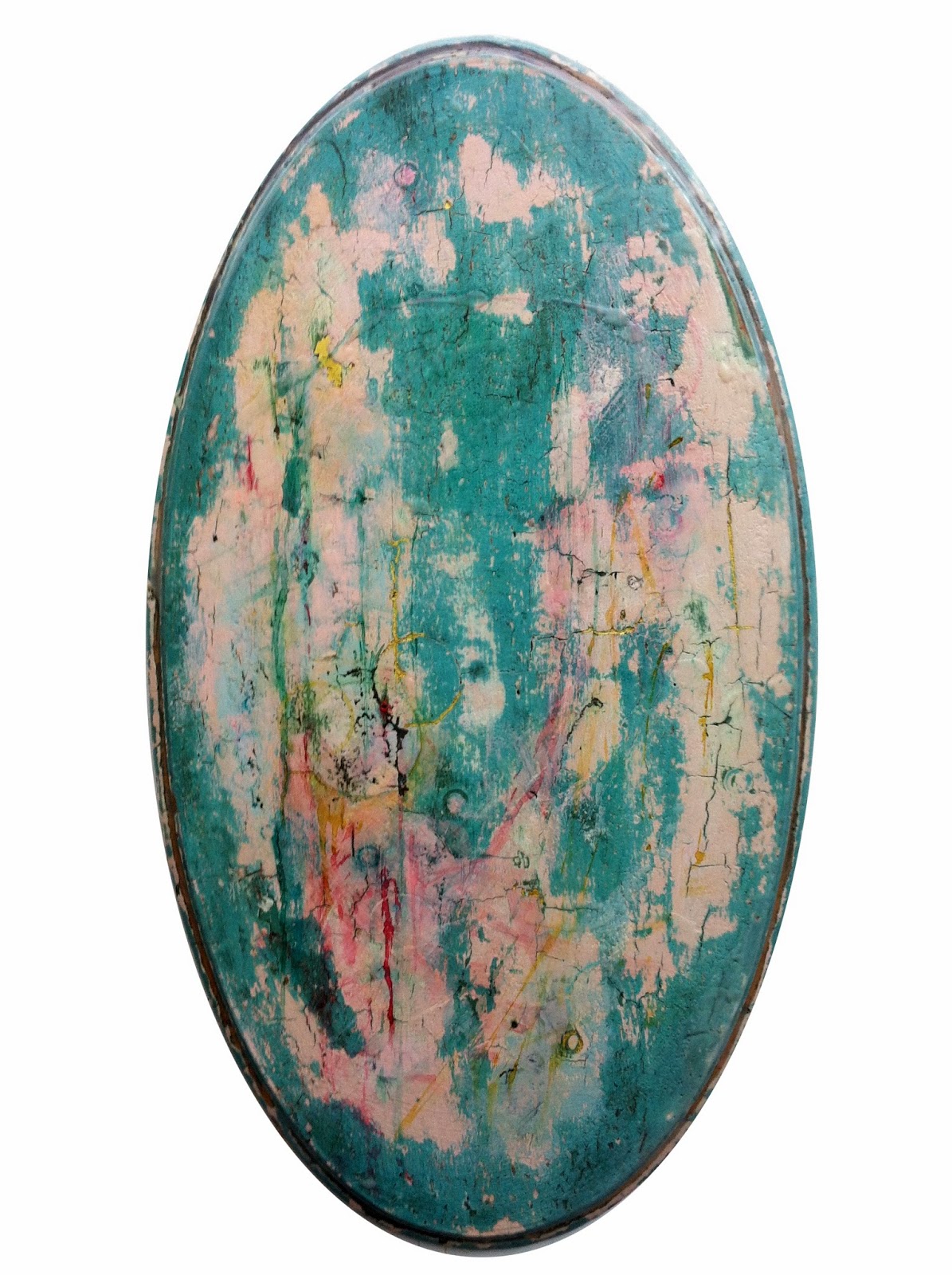
Kindness

My challenge in this endeavor was to express the concept of kindness without resorting to an illustration of someone or something we equate with kindness.  I wanted to evoke the impression of kindness without illustrating it.

I spent a long time just thinking about what kindness would look and feel like in abstract concepts.  What shape is kindness, what color, what type of marks.  At some point the image of an oval took shape in my mind. For me, an oval carried a certain type of presence.  The verticality, referenced the human body, the oval felt inviting and encompassing, compassionate.  So the search was on for an oval piece of wood. I enlisted the aid of a friend of mine that often helped out in estate sales. I told him to keep his eye open for on oval tabletop.  I still hadn’t figured out what sort of imagery or colors would evoke kindness.  I found an inexpensive veneer table at a thrift store for backup, in case my friend never uncovered anything better.  I was uninspired by the veneer table, but I still responded to the shape, it felt right.

After a couple months of pondering, I received a phone call from my friend saying that he had found a table, but that it was old and had several layers of paint on it and he asked me if I wanted him to sand it down a bit. I was thrilled. I asked him if he could take off the legs as well, and that if he wanted to sand it a bit that would be great, to “knock himself out”.  I was anticipating that I would need to gesso it to prep for the painting and the sanding would speed my process. 

What I didn’t anticipate was the innate beauty of the scarred tabletop revealed by the random sanding.  When my friend presented me with it, I gasped.  He has no artistic training, and probably thought I was crazy, to him it was just a worn table top desperately in need of a paint job. But to me it evoked a lifetime of service.

At that point, it was obvious to me that I needed to work with what had been revealed and not totally obfuscate it.  The whole process had involved kindness on the part of my friend.  He had searched, he had found, and he had prepared the table. It was his offering of kindness to me.

I began to slowly respond to the marking left by years of use.  There were circular rings left from sweating water glasses, and other circular marks I couldn’t identify.  There were deep cracks that refused to be healed by my layers of hot wax that I applied in light colored glazes.  I began to appreciate those cracks, and the delicacy of their mark. I opted to work with the colors that remained stubborn to the sanding attempts. Kindness requires that sort of stubbornness, that persistence.  I worked to unify the existing marks and introduced more circular elements and a rhythmic movement.  However, the real kindness in this piece is the complete conceptual package, all the pieces that brought it to life, including all the years it spent in service as a humble table.


Sunday, January 19, 2014

I Believe


The other day a student asked me whether I could come up with four or five questions that an artist could internally ask to help figure out where they want to go with their work. I wish I could think of an easy answer, but I fear it is a life long pursuit. That is both the good and bad news. If there were an end to the journey, then once it was reached what incentive would there be to press on? The bad news is that this means you are embarking on a journey of self-discovery that will more than likely be never ending, with the destination always feeling just beyond your reach. The more we know, the more we realize there is to know. At first it is easy because your focus is on perfecting the craft of your work. The real struggle only begins once you have achieved most of the technical hurdles.  That is the point when you must no longer draw from what is outside of you, but begin to draw from the well within you. This may feel daunting at first, but you need to just focus on the next step of your journey.

I believe there is more to art than just reproducing what something looks like. I say “just” but I realize that painting what something “looks” like is not an easy task, which is why so many artists continue to spend so much time trying to do just that.  Don’t misunderstand me, I am not discounting the need to perfect craft, I just don’t think that is the final destination. Once craft is perfected we may find ourselves thinking “now what?”  If perfecting craft is your present goal along this journey and it brings you satisfaction, then continue on. When the goal of perfecting craft has been achieved, you may feel yourself questioning whether there is something more to discover.

This does not have to be some sort of deep trip into psycho self-analysis.  But, it is the realization that all art is a form of communication. There is room for all levels of communication. It depends on what you are trying to communicate and who you want to be in conversation with. I think that music is a good analogy. Musicians must hit the right notes, but great musicians do more than hit the right notes, they impart something of themselves in the performance. There is more than the accuracy of their craft. There is something that can’t be described. That “something” is fleeting in a musical performance, as painters, we seek to give that “something” permanence in paint. Kandinsky did his best to explain this phenomenon.  He felt that a work of art is a physical object that springs from the inner being of the artist, but it is also the trigger point that begins a reverse process back into the inner being of the viewer. So the physical work of art becomes the bridge to an inner experience that was deeply felt by the artist.  If there is no initial force that was deeply felt within the artist, the work may be visually pleasing and adept, but lack that emotional bridge and connection. This connection is similar to the one that makes us weep when we hear a musician perform a piece with all his being.  We all have been moved my real art. But how do we create it?

Whatever your subject matter is, your painting should strive to be your intimate reaction to something. If what you see is all I get as a viewer, then art has lot some of its purpose and power.  I believe that the artist is more than a cook that knows how to put the ingredients together to make a tasty meal. As an artist, you must find the secret ingredient that only you possess.  You must somehow transform the materials into something that is more than the summation of its parts. As I often say, depending on your religious persuasion, you are either searching for magic or the hand of God in your work!

So back to my students question; if the answer lies within you, then that is where you must look for clues. We are very good at hiding from ourselves. A good idea is to keep a small journal where you can write down notes.  Perhaps begin a list of words that resonate with you, or sometimes one will jump out when you are reading. Write it down. Start to figure out what really interests or puzzles you. Do you like things organized or chaotic? What type of things do you collect? What makes your happy, what makes you angry?  Is there something that currently perplexes you? What is your personality, for better for worse? Make a list of adjectives that describe you, list your preferences and your dislikes. Watch for things that trigger you during the day for good or bad and write them down. What do you want to say?  If tomorrow was your last day on earth, and your next painting was all that was left behind to communicate to the future, what message would you want to send? Would you yell it or whisper it?


These are just possible jumping off points to begin a series. A series becomes the next step on your journey to discovering meaningful work. A series may go 4-6 paintings and then be exhausted, but lead you in a new direction. Or, a series may take 100 paintings to work through.  The important thing is that you start thinking about your work as being more that the depiction of something, it is something new and separate that has been created by you, through you, because of YOU.  Begin to paint what only you can paint!

Friday, December 2, 2011

Accepting the Stranger


One of the largest obstacles we face as artists is our limiting belief system regarding art. We say we are constantly striving to become “better” artists and we often approach this task by rejecting work that doesn’t appeal to us and seeking out art that reinforces our idea of what is good, what is to be emulated in our own work.

I met a young man the other day, probably around 16 years old. When his mother learned that I was an artist, she remarked that her son had talent but that he had run into a couple of art teachers that had discouraged him and that now he hardly drew at all anymore. Our first instinct is to condemn the insensitive art teacher, but my first thought was “well, if that is all it took to deter him, he might as well find another profession, for he is certainly going to run into more obstacles than a few discouraging teachers.” But of course, I didn’t say that. As a teacher myself, I was curious. After talking with the young man a while, I discovered the same blocks that subvert us all. He had already decided that he “knew” how and what he wanted to draw and didn’t want teachers telling him what to do. He was more than likely afraid of potential failure if he tried out the unfamiliar, the risk was too great. In reality, I am sure the teachers saw some raw talent that would have benefited from some rudimentary exercises that would continue to improve his drawing skills. They wanted to give him more tools, perhaps some color theory, maybe a few projects he didn’t find instantly pleasing or relevant for what he had already determined was important for him. At 16 he had already closed the door to what was foreign to him, the risky unknown. He had already limited his ideas to his narrow definition of what “he” liked to do. But I say that to limit ourselves to what we like is extremely limiting. I love it when people remark, “I don’t know much about art, but I know what I like” because the truth of that statement is really “I like what I know” and in reality I “know very little”. We can only expand what we know by inviting the stranger in. The more we open ourselves to the unknown, the more we discover there is to know, and that takes a certain amount of courage.

When we were infants, we responded to the familiar: our mothers face, a favorite blanket, or a favorite food. We loved it because it was familiar and comfortable. We rejected the things we didn’t like because we didn’t understand their potential value, they were foreign. Surely this analogy can be extended into many areas of life. It is a handicap we all share and I am no exception. We all like what we know, it is comfortable. In art, we recognize something that we have been taught is “good” or we have seen and appreciated before perhaps in a “master” work. But the flip side of that is that we often condemn what we don’t recognize – what is foreign and unfamiliar to our senses. The paradoxical nature of being an artist, a creator, is that we are often in search of the new. In fact, every great movement in art or artist that has endured 100 years after deceasing to exist discovered something new that was at first rejected because it was unfamiliar. People “liked what they knew” and on the flip side, hated what they didn’t recognize.

In Jonah Lehrer’s book “Proust was a Neuroscientist” he has a chapter about Igor Stravinsky. He talks about the first time that his music for the ballet “The Rite of Spring” was performed. Stravinsky wanted to create a “new” sound, one unfamiliar to his audience. One that challenged the way they thought about music, one that didn’t simply pander to the audience’s expectations. As the music began to build with clashing tensions and merciless momentum the audience began to scream and a riot ensued. They couldn’t bear the unfamiliar. They rejected the noise that was pretending to be music. According to Lehrer, “for the audience, Stravinsky’s new work was the sound of remorseless originality”. The crowd was expecting more of the familiar. “With The Rite Stravinsky had announced that it was time we learned something new”.

This is the take away. Our minds are more like plastic than stone, we can adapt to new ideas, we can accept the stranger in and eventually he may become an old familiar friend. In the case of music, neuroscience now knows that “our sense of sound is a work in progress. Neurons in the auditory cortex are constantly being altered by the songs and symphonies we listen to. Nothing is difficult forever”. I would extend this analogy to all art. We expect certain color harmonies, patterns, etc. We are taught to recognize the ones that are “pleasing”. When we come across an artist that challenges these norms, we revolt; it goes against everything we “know”. Eventually, given time, if we are willing to engage with the stranger we may see the innovation and learn to appreciate a new way of seeing.

So, what I hope to inspire, is that when we are faced with a new idea about art, or we see someone that has created something we don’t understand, or we are given advice by an instructor that just feels incredibly foreign – we can learn to suspend judgment. We can instead try it on for a while, let it sink in and simmer. It may never resonate or it may at some unexpected point in time cause us to say “aha, now I see”. To condemn the foreign is to shut the door to potentially expanding what we “like”. We must accept that our definition of art is always growing and expanding. Growth in this field depends on letting in ideas that may undermine our current beliefs. Beliefs are limiting and continuing to reinforce them will only limit the potential of art. The more we allow in, the more choices we have which in turn can make the decision process more difficult, but it is through the difficult choices that the largest reward comes.

Now, the catch, the more we expand and discover, the less familiar our work will become to others. Our work may become unpopular as fewer and fewer people have journeyed the same path as you so fewer will recognize anything familiar. Always remember that popular art certainly doesn’t equate with good, meaningful art, but it sure makes us feel good when we are popular! When our work becomes less popular, our self-esteem may plummet as well. But not if we remind ourselves that people “like what they know”. Hopefully people will take the time to get to know your work, and when given the opportunity we can help educate them. If one is sincere, and continues to work in a heart felt meaningful way, there will always be those that will recognize that sincerity, we must just be patient.

Tuesday, January 11, 2011

Subjective vs. Objective


We often say that the value and merit of a work of art is subjective. That there is no real way to objectively discern a good painting from a not so good painting, that it is just a matter of opinion and unfortunately there are plenty of people willing to freely give theirs. Objective truth is a truth that exists independent of thought or an observer. This is the sort of truth that Cezanne was speaking of when he told Emile Bernard that the next time he spoke with him he would explain to him the truth in painting. Unfortunately, Cezanne died before he was able to convey that truth. Still, the notion that there is a truth in art is a question that has plagued many philosophers and sages much wiser than I. But back to the question, is Art subjective or objective? I believe that what is subjective is the knowledge of the critic or observer. I believe as Cezanne did, that the work, if done sincerely has an objective integrity and truth. It is the viewer that is often flawed by his own limited perception and belief systems. Another thought often misquoted is “a little knowledge is a dangerous thing”, if it were really “knowledge” it wouldn’t be dangerous. What often takes the place of real knowledge is belief, and as Plato pointed out, our beliefs are not always justified, but built on prejudices and misinformation. The reason the value and merit of art seems subjective, is that there is so much to learn to understand and appreciate about art and we are all limited beings who are destined to only glimpse a part of it. Through constant study, observation, and the willingness to remain open to the truth as it presents itself, I believe we can attain certain objectivity to the truth in art. We have to be willing to let go of the preconceptions and definitions we build along the way when new possibly conflicting truths are revealed. We must be satisfied by knowing we can never know the whole truth, because art refuses to be defined and limited, but that is exactly what makes it so powerful.

Sunday, November 14, 2010

To become a better artist?


I began this years teaching by asking my students what their goals were. A common response was "I want to become a better artist". Hmmmm. So, I have been given the arduous task of asking them to define what "better" means to them. Do they mean technically better? Drawing more accurately, seeing more accurately, finding color notes better? What do they believe getting better will achieve? More sales? Respect from other artists? Personal joy? All of the above? Unfortunately, the sad truth is, the better we become as artists, the more critical we become and the more it takes to wow us, so "better" is a goal that keeps on moving further and further away. I used to be able to go to an art show and come away inspired, now I often come away disappointed. It is hard to find anything of merit other than technical prowess and more of the same. The more of a connoisseur we become in anything, the harder it is to find things that satisfy our sophisticated palette. Think of wine and cheese. The same is true in art. The more I know about painting, the more I want to see artists find new ways of solving old problems. As a painting teacher, I feel I am not teaching them a craft that is to be proliferated redundantly, I want them to create work that comes from their individuality. Individuality often means non-conforming so it doesn't always translate into popularity as the majority of people will admire and praise the familiar.

One of my favorite authors on this subject is Peter London. In one of his books he cautions that anyone can be taught how to paint like Monet, stroke for stroke, but although the external result may look the same, the internal process is totally different. It is like jumping to the end of the story and only reading the last page. Every choice Monet made in refining his technique came from personal discovery. He didn't begin as an impressionist painter he evolved and discovered a new way of seeing that was uniquely his own. A way that was vehemently rejected by traditional art norms of the day.

So for me, becoming a "better" artist, is to become an artist that continues to search and remain open to the discoveries that are revealed along the way. "Better" doesn't guarantee "satisfied", to continue to grow, we must never be stalled by anyone's satisfaction, even our own!

Wednesday, July 21, 2010

Probing the familiar


There is a certain thrill that comes from painting outside. I understand the thrill. The quest for the perfect subject matter to inspire and motivate, the ever-changing light and atmosphere, and let’s not forget the bugs. I remember my own personal journey. My feeble attempts to match the colors I perceived, to be the noble scribe recording nature exactly as it presented itself. But, I also clearly remember the first time I was able to use an on site scene or photograph as only a means of departure, the freedom I felt when I realized I could compose and move things about for reasons beyond imitation and representation. The day when I had mastered color enough to actually create atmosphere and light of my own desire, no longer a slave to the scene before me, I was now moving forms through space by the shift of a value or temperature.

I am pondering this transition today, because I just had a show of my newest work. I am well aware that there are people who do not understand what I am doing these days, those who miss my interpreted illustrations of familiar scenes. Why the preoccupation with these houses? Over and over, I reinvent their planes, colors and shapes. I am no longer poring through photographs and running to one new site after another searching for subject matter. Some may think I’ve just given up, settled on some familiar motif for the purpose of sales -- far from it. I have discovered that the deeper I am willing to prod the familiar, the more it reveals to me. It is difficult to push beyond the surface appearance of things to create something new. It is easier to divert by finding some new subject. But now, I have discovered that I keep finding new revelations in manipulating familiar shapes into new patterns. I witness the way the sun crosses the sky and causes a different shadow pattern I never noticed before and suddenly I have a whole new series to work on. It has become more about relationships, the relationship between the interior shapes of the structures and the exterior shape of the picture format. It is the subtle shift from one hue as it confronts another; it is the distillation of all that subject matter into simplicity of form. Less is more. How far can I take it? One color changes and all the rest must be altered. What if the sky is yellow-green this time? I have become the creator, and this is so much more thrilling than the role of imitator!

As an aside, I once thought that Milton Avery couldn’t draw. Pretty colors, interesting shapes, but obviously he couldn’t do anything else or surely he would. I mean, they are so simplistic…or are they? I discovered an academic drawing he did of a standing nude. Believe me, the man can render as well as DaVinci. The search for simplicity was intentional, and the more I learn about color, the more I realize his choices are not simple at all. So my new mantra is to not dismiss something simply because I do not currently understand it.

To view my recent show, please visit www.addisonart.com and click on the link to Mary L. Moquin.
The painting above is titled "Harmonic Intervals" 11 3/4 x 12 Painting resembles music in many ways; there is a structure and a rhythm. Finding the perfect balance between shape, color and atmosphere creates pictorial harmony. This painting is orchestrated in a way that every note plays an integral part in the harmony of the painting, similar to a small ensemble of voices each holding their part of the whole.

Thursday, June 10, 2010

Discovery vs. Plan

To plan or not to plan, that is the question I’m pondering. I taught a workshop over the weekend I have titled “Three Steps to Stronger Painting”. I have given this workshop several times over the last 5 years. However, this is the first time I have given it since completing my MFA. When preparing, I considered how my thought process has evolved and reflected on how much of the content of the workshop was still relevant to my current process. The workshop is very structured and methodically explores the formal concepts needed to create strong paintings: composition, value, and how color translates into value. At this point in my life, these tools have become so intuitive that I realize I no longer see them as separate steps. It is like learning a particular dance. It is necessary to know the pattern of the steps to learn the dance, but we can only dance when we stop thinking about the individual steps! That doesn’t mean we should just ad lib across the floor when a waltz is played (although that is fine, just don’t claim you are waltzing). So, back to planning - thumbnail sketches, value studies, color charts; these are the scales the musician practices daily, the steps to the particular dance. The artistic allusions go on and on. The artist learns to orchestrate the picture plane. But, at some point in his career, he may realize how automatic it has become, and how easily he can turn out a beautifully controlled composition, complete with strong value patterns, and brilliant color correlations. At this point, it is time to relax the control. Trust in the years of planning and orchestrating, and now let the painting direct the course. The role of the artist now transforms, listening to the flow of music and recognizing the magical moments. The artist no longer controls every mark and movement, he watches, he discovers, he no longer imitates - he creates.

Saturday, May 1, 2010

What I used to know......

Once upon a time, I thought that art was something that was capable of being fully understood. I guess I thought it would be like learning to bake a cake. Given the raw ingredients and instructions on how to put it all together, I would be able to come up with a successful cake/painting. I have discovered that art tends to be a bit more elusive than this. In fact, the greatest lesson I have gained from years of study complete now with my Masters of Fine Arts in painting, is how much I really don't know. At one time this realization might have caused me great anxiety, and certainly at 18 who wants to be told that they will really never know all the answers. I am actually okay with realizing that I don't know everything there is to know about art, because to believe I know that would be to limit its potential. I believe that those with strong opinions have done just that, limited their options, and narrowed their vision for the security of feeling they have the answers. It is a bit like the 4 blind men trying to describe what an elephant looks like by the area they have touched. Art is like the elephant, larger than any of us can see totally with our limited human faculties. We are all striving, searching, developing, trying to
understand the part we have begun to grasp. But, I believe the danger comes when we think we have figured it out and go on to profess what we have discovered as the only truth. Then we close ourselves off to future discovery, then the different artistic groups clash, claiming it is about the color, value, line, no line, expression, observation, realism, abstraction, impressionism, expressionism etc., etc. I fall back on, the more I know, the less I know, the more I need to know, that is what keeps me honest as an artist. Emmerson said something like, speak your truth today and tomorrow speak your truth again even if it contradicts what you said yesterday, because "consistency is the hobgoblin of little minds". When you discover something new about art, especially when it contradicts your old beliefs, embrace it. Perhaps you have grasped a bit more of that elephant and what you have felt contradicts what you originally had surmised.
What an exciting opportunity for growth!

Sunday, April 11, 2010

Overworking fears

Many artists speak to me of their fears of 'overworking' their paintings. Often I find this fear prevents them from pushing their paintings further for fear of ruining them in the process. I don't believe that overworking is necessarily a by product of working too long on a piece. It's working too long without a clear concept or direction. Or, let's put it this way, overworked pieces can still be revived, sort of like what I hope a vacation will do for me.
When at a loss, put the overworked painting aside. Somewhere that you can glance at it now and then. One day it will call you, when you're not so invested in it, and you'll know what it needs and you can either fix the problem right there and then or start a fresh painting right over the previous one if need be. Paintings painted over previous paintings are some of my best paintings, some of the history of the previous will show through adding a new dimension of beauty. The new marks will be fresh, because you are fresh and your vision is clearer. I have resuscitated many a painting this way. Stopping a work prematurely from fear of overworking to me is worse, it is playing it safe, where is the real 'creation' in that? Creation involves risk and new discoveries.